Category: Uncategorized

  • You Don’t Have to Love Code (But You Still Need To Love The Process)

    soundtrack by Dopo Goto

    I’ve been thinking about whether someone can get good at building software using AI if they’re not interested in programming. With tools that can generate substantial amounts of code from natural language descriptions, it’s tempting to think coding passion might become optional. My hypothesis is that while the required skills are shifting, you still need to love something about the process to succeed in building and shipping useful things.

    Let me share a recent example: I spent multiple hours recently working with an AI assistant to update what should have been a simple note organization component. What started as “just let me edit all the tags” turned into an episode of wrestling with state management, dealing with race conditions, and questioning my sanity. The AI could generate code quickly, but it couldn’t give me the persistence to push through when things got messy.

    This experience highlighted something crucial: one of the hardest parts of software development isn’t necessarily about writing code. It’s about having the stubbornness and curiosity to:

    1. Keep debugging when your “simple” change unexpectedly breaks three other things
    2. Question your assumptions when you’re given plausible-looking code that doesn’t actually solve your problem
    3. Start over when you realize your initial approach won’t scale, even if your code is a dazzling work of art
    4. Admit when you need another human’s perspective, even especially if you’re scared of looking dumb or having wasted your time

    The social dimension is also critical and often overlooked. Even with incredibly capable AI assistants, building valuable software remains a fundamentally collaborative process. The AI doesn’t have perfect information to work with when it helps you make decisions. You will always have blind spots. If you have a good team (whether that is a team at work or generous strangers on the internet) they will help clarify this lack of information (be it parallel efforts, product requirements, tribal knowledge, etc.). In other words, you need to be comfortable with stuff like:

    • Having your assumptions challenged
    • Explaining and defending your decisions
    • Admitting when someone else’s approach might work better

    I’ve noticed that the people who really succeed with building solutions and making them better aren’t necessarily those who love coding for its own sake. I’ve often faced the stereotype myself where programmers are people who love solving puzzles. Personally, I was never a puzzle solver. When I got started I just wanted to make the things in my head show up on a screen. Luckily for me, that turned into a fulfilling career.

    From what I’ve observed so far, the people who succeed at working with technology in the long term are the ones who:

    • Get obsessed with hard problems
    • Stay curious about how things work
    • Value adaptability (i.e. they practice some form of continuous improvement as it applies to their systems, and have a “growth mindset” as it applies to themselves)
    • Are OK with being wrong
    • Develop the persistence to push through obstacles (a.k.a. “grit“)

    So while AI might change how we write code, it doesn’t change the need for genuine interest in problem-solving and creating useful things. The focus of this interest might largely shift from loving a language to loving the process of breaking down complex problems, but something needs to fuel you through the inevitable challenges and ego-busting revelations.

    (Side note: I’m self-consciously avoiding using the word “passion” here which I associate with the stereotype of someone spending nights and weekends sleeping under desks and poring over code. While many people have a positive association with that type of passion, I personally think that its outdated, overrated, and limits our perceptions of what success looks like.)

    Maybe instead of asking whether someone needs to love programming, we should ask: Are you excited enough about what you’re building to push through when AI can’t solve everything? Are you OK with throwing everything away when you realize that someone else already does it better, and then helping that person instead? In short, do you actually enjoy the process? These are all things I keep trying to ask myself, regardless of how (or how often) I create code.
  • Want to get better at prompting (and talking?) Try talking to your computer.

    soundtrack by Deep Sea Current and theycallhimcake

    Lately I’ve found myself talking to my computer more. Not just when I’m mad at it, but also when I’m writing code using AI-assisted tools like GitHub Copilot or Cline. It’s a shift that happened organically as my role evolves from being the primary “driver” of code to more of a “navigator” who guides the overall direction.

    What’s interesting is how this practice can improve communication in both human and machine interactions. When you have to verbalize your intent clearly enough for speech-to-text to understand, you naturally become more precise in your explanations. It’s like the old rubber duck debugging technique, but now your rubber duck can actually respond and help refactor your code.

    There’s also a physical benefit that I can’t ignore. As someone who has spent countless hours hunched over a keyboard like Gollum with his precious – slowly de-evolving, watching my hands morph into claws – this alternative feels like discovering a cheat code for programmer ergonomics.

    It’s not perfect. There’s still plenty of situations where I need to take the wheel, due to both limitations of speech-to-text interfaces and the ability of intelligent coding tools to carry out instructions. But I can definitely feel the difference, even if its not something I can do all the time.

    Going beyond the physical benefits, the real value might be in how it changes the way we think about programming interfaces. We’re moving from an era where we had to speak the computer’s language precisely, to one where we can express our intent more naturally. Computers are becoming better at understanding us, rather than the other way around. It’s another small step toward that Star Trek future where we can just say “Computer, refactor this method to use the Strategy pattern” and actually get meaningful results.

    Of course, your mileage may vary depending on your environment and tolerance for looking like you’re talking to yourself. But in a world where many of us already spend our days talking to screens, maybe that’s less of a concern.

  • Botstrapping: A New Approach to Getting Started

    soundtrack by FIREWALKER

    bot·strap·ping /bɒtˌstræpɪŋ/ n.

    1. The practice of using AI tools to rapidly generate initial versions of code, content, or project structures, with the expectation of significant human refinement. “I used botstrapping to get the basic API endpoints in place before customizing the logic.”
    2. A project initialization technique that leverages AI assistance to overcome startup inertia, even when the output requires substantial editing.

    I’ve never used this term out loud, but in my head it perfectly describes a pattern I’ve noticed in my workflow. The term plays on “bootstrapping” – which has evolved from a satirical phrase about an impossible task (pulling yourself up by your own bootstraps) into a metaphor for self-reliant progress. In computing, it describes loading a simple system to launch a more complex one. In business, it means building something without external resources.

    “Botstrapping” intentionally inverts this self-reliance. Instead of pulling yourself up, you’re letting a bot give you a boost – even if you know you’ll need to clean up after it. It’s like having a very eager but sometimes confused intern who can get you 60%-80% of the way there in 10% of the time.

    What I find interesting about botstrapping is how it changes the psychology of starting new projects. That blank page anxiety gets replaced with the more manageable task of editing and refining. The bot’s output might be messy or even completely wrong, but it gives you something concrete to push against. It’s like having a sparring partner for your ideas rather than shadow boxing alone.

    Of course, there’s an art to effective botstrapping. You need to recognize when the foundation the bot has laid is fundamentally flawed versus when it’s just rough around the edges. Sometimes starting fresh is still the better option. But I’ve found that even the process of explaining to the bot what you want to build can help clarify your own thinking.

    The real value isn’t in the code or text the bot generates – it’s in how it changes the activation energy required to start something new. And in a world where getting started is often the hardest part, that’s not nothing.

  • The Artisanal Craft of Text Generation

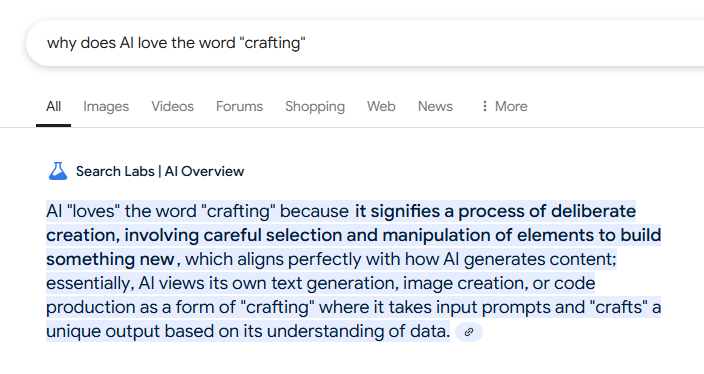
    There are some words that LLMs really like using at the moment. One of them is using the word “crafting” as a word to mean “creating” or “writing.” I asked Google for thoughts on why that is:

    This rings true to me. I also suspect this reflects how these models were trained on content that tried to sound more sophisticated than necessary. Think LinkedIn posts, technical documentation, and marketing copy – places where people often reach for fancier words to add gravitas.

    It’s also telling that “craft” implies careful, intentional work. The creators of these models would prefer to present them as thoughtful artisans rather than mass-production text factories. But there’s something amusingly ironic about an artificial intelligence repeatedly choosing this artificially elevated language.

    Maybe we need to craft (sorry) a new word that better captures what AI is actually doing.